
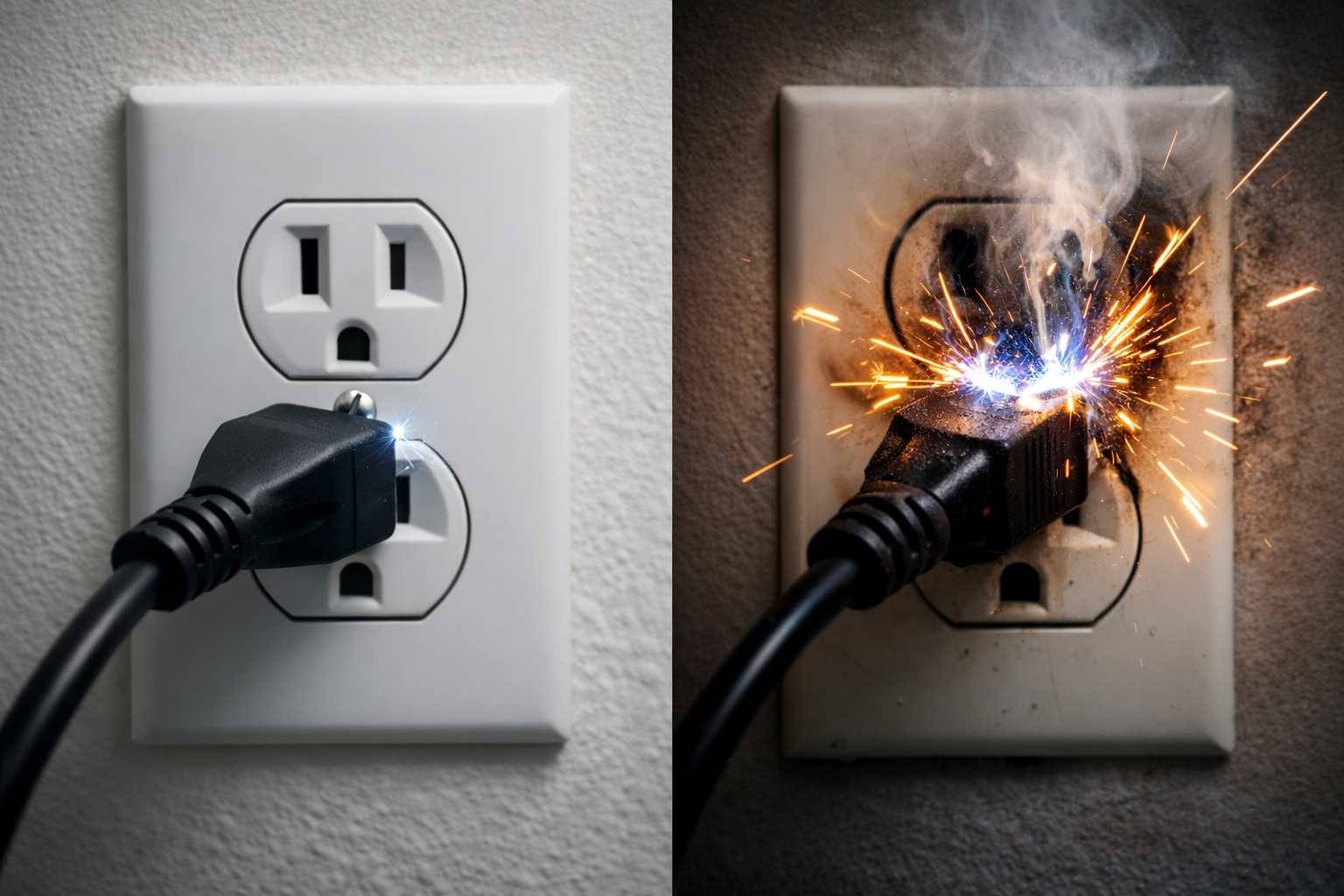
Few sights make a homeowner’s heart drop quite like seeing outlet sparking the moment they plug in a device. That split-second flash of blue or yellow light is alarming, and rightly so—electrical fires are a leading cause of home structure fires in the United States. However, not every spark signals impending disaster. Some sparks are completely normal and happen inside millions of homes every day without consequence. The challenge is learning to distinguish between a harmless static discharge and a dangerous electrical arc that requires immediate professional intervention. This guide will walk you through the physics behind the flash, explain exactly what your outlets are trying to tell you, and help you determine when to call the experts at Tried & True Electrical Services Inc. to keep your family and property safe.
The Science of the “Normal” Spark
To understand outlet behavior, it helps to think of electricity like water flowing through pipes. When you plug in a device, especially one with a motor or a switching power supply—think refrigerators, phone chargers, or vacuum cleaners—the appliance immediately demands a surge of current. This sudden rush creates a brief, tiny arc between the prongs of the plug and the metal contact points inside the outlet. This is often seen as a quick blue flash that lasts less than half a second. This type of outlet sparking is similar to static electricity you feel when touching a doorknob in winter. It is high-voltage but extremely low-energy, and it dissipates harmlessly. Another completely normal scenario occurs with devices that have polarized plugs (one prong wider than the other). These are designed to make the neutral connection first; the brief spark you see is simply the circuit completing its path. As long as the spark vanishes immediately and the outlet faceplate is not warm, loose, or discolored, this occurrence is generally nothing to worry about.
When the Spark Signals Danger
While a tiny, instantaneous flash is usually benign, any deviation from this pattern warrants concern. A dangerous arc—often referred to by electricians as “series arcing” or “parallel arcing”—is a sustained electrical discharge that generates intense heat, often exceeding 10,000 degrees Fahrenheit. This heat is the primary ignition source for electrical fires. So how do you identify a hazardous arc? First, look at the color. Normal sparks are typically blue or bluish-white. Dangerous arcs often appear yellow, white-hot, or even greenish, and they may be accompanied by a buzzing, sizzling, or crackling sound. Second, assess the duration. If the spark continues after the plug is fully inserted, or if it lingers for a second or more, the outlet is actively failing. Third, check the physical evidence. A burning smell, black soot around the prong holes, a warm or vibrating faceplate, or visible scorch marks are all signs that the outlet has suffered internal damage and is now a legitimate fire hazard.
Common Causes of Hazardous Outlet Sparking
Understanding why dangerous arcs occur helps homeowners prevent them. The most frequent culprit is wear and tear. Standard outlets are rated for a certain number of plug insertions—typically around 10,000 to 15,000 cycles. Over years of use, the metal spring contacts inside the outlet lose their tension. When the contacts become loose, they no longer grip the plug tightly. This creates a small air gap between the metal surfaces. Electricity does not like jumping across air gaps; when forced to do so, it creates a high-resistance arc that generates extreme heat. This is why an outlet that feels “loose” when you insert a plug should be replaced immediately.
Another common cause is overloading the circuit. When you plug too many high-wattage appliances into a single outlet (often via power strips), the constant demand for current overheats the wiring and the outlet contacts. This can lead to carbon tracking, where conductive carbon deposits form on the plastic outlet housing. These deposits provide an unintended path for electricity, causing it to arc across the surface of the outlet rather than flowing cleanly through the metal wires. Finally, age plays a role. If your home still has two-prong outlets, or if the outlets feel brittle and plastic-like, they likely predate modern safety standards and are more prone to internal arcing.
Why You Should Never Ignore the Problem
Some homeowners attempt to solve the problem with a quick fix—bending the prongs of the plug, inserting the plug upside down to make it fit tighter, or simply avoiding that specific outlet. These are temporary measures that ignore the root issue. A dangerously sparking outlet is a progressive problem. Each arc erodes a microscopic amount of metal from the contacts and the plug prongs. This erosion creates uneven surfaces, which increases resistance and encourages more arcing on the next use. It is a feedback loop that accelerates toward failure. Additionally, the problem may not be isolated to the outlet itself. Sometimes, the arcing occurs not at the receptacle, but at a loose connection further upstream in the circuit—inside a wire nut behind the wall, for example. In these cases, the outlet is simply displaying the symptoms of a deeper electrical fault. The only way to diagnose this accurately is with professional tools like thermal imaging cameras and circuit testers.
Immediate Steps to Take
If you witness outlet sparking that seems abnormal—specifically, if it lasts longer than a blink, smells like fish or burning plastic, or leaves black marks—take action immediately. Do not use the outlet again. Go to your electrical panel and switch off the circuit breaker that controls that room. If you are unsure which breaker it is, turn off the main breaker to cut power to the entire house. Place a piece of tape over the outlet and warn household members not to use it. This is the point where you should contact a licensed electrician.
Tried & True Electrical Services Inc. specializes in diagnosing and resolving these exact issues. Their certified electricians can perform a full inspection of your home’s wiring, identify any loose connections or failing components, and replace outdated receptacles with modern, safer models. According to the Electrical Safety Foundation International (ESFI), homes with old or damaged receptacles are significantly more likely to experience electrical fires. Upgrading to tamper-resistant (TR) outlets or those with arc fault circuit interrupter (AFCI) protection provides an additional layer of safety, as these devices can detect dangerous arcing and shut off power before a fire starts.
Prevention: Modern Solutions for an Old Problem
The best way to handle outlet sparking is to prevent the hazardous type from occurring in the first place. If your home is more than 20 years old, consider scheduling a whole-house electrical safety inspection. This is not just about outlets; it is about verifying that your system can handle the demands of modern appliances. Furthermore, be mindful of what you plug in. Space heaters, for example, should always be plugged directly into a wall outlet—never an extension cord—and should be unplugged when not in use. Regularly inspect your outlets. Gently press on the faceplate; it should be cool and secure. Insert a plug and remove it; it should require moderate resistance and hold the plug firmly without sagging.
Conclusion
Outlet sparking is a classic case of context being everything. A brief blue wink when connecting a device is physics in motion. A sustained, noisy, yellow spark accompanied by heat or odor is a cry for help from your electrical system. Never gamble with electricity. If your instincts tell you something is wrong, they are probably correct. Trust the professionals who deal with these issues daily. For reliable, honest, and prompt electrical service, visit Tried & True Electrical Services Inc. to schedule an appointment or to learn more about upgrading your home’s electrical safety. When it comes to protecting your home from electrical fires, there is no substitute for expertise you can truly trust.