
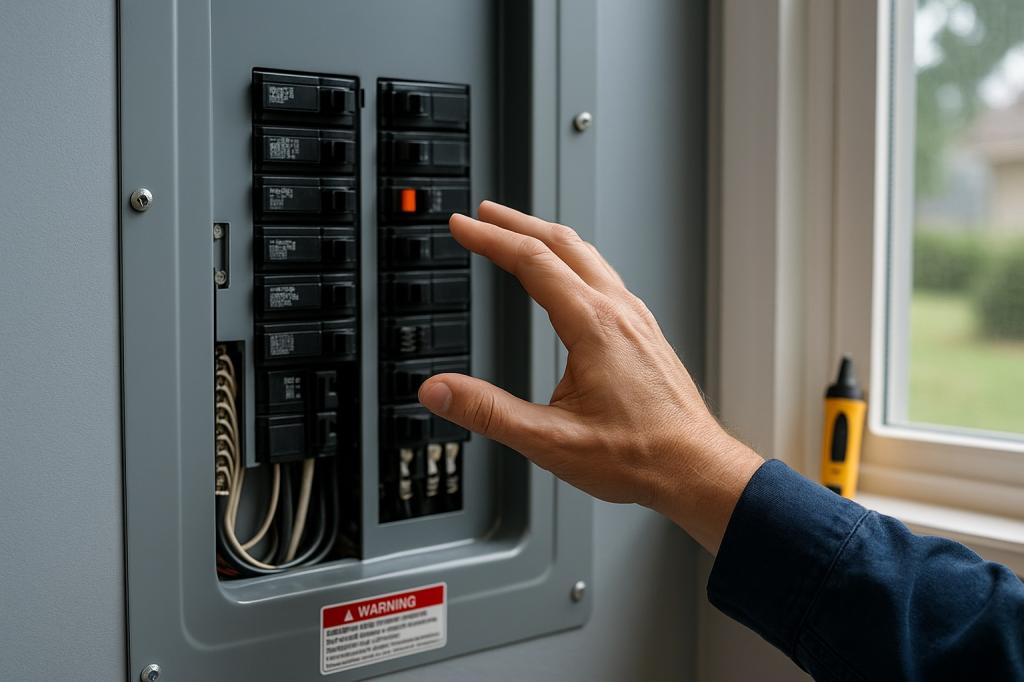
If your breaker keeps tripping, you’re not alone. Our electricians in Charlotte, NC see this daily, and the root cause usually falls into one of three buckets: overloads, short circuits, or ground faults. This guide shows you how to spot the difference, what you can safely check, and when to call a licensed pro.
The 3 Most Common Reasons
1) Circuit Overload
What it is: Too many devices drawing power on the same circuit.
Clues you’ll notice:
- Breaker trips after you turn on a space heater, microwave, vacuum, hair dryer, or window A/C
- Lights dim when large appliances start
- Warm breaker or warm outlet plates
Why it happens: General-use 15–20A circuits weren’t designed for multiple high-draw appliances at once. Older homes often have fewer dedicated circuits.
Typical fixes:
- Redistribute loads to other circuits
- Add a dedicated circuit for the heavy-draw device
- In some homes, a panel/load center upgrade is the right long-term solution
2) Short Circuit
What it is: A hot (live) conductor touches neutral or ground, creating a very low-resistance path and instant high current.
Clues you’ll notice:
- Breaker trips immediately when you flip a switch or plug something in
- You may smell a burnt odor; outlet/switch looks scorched or discolored
- A device or cord recently got damaged
Why it happens: Damaged cords, loose back-stabbed connections, nicked insulation, or failed devices.
Typical fixes:
- Replace damaged cords/devices
- Correct faulty terminations inside the outlet/switch box
- Repair wiring faults and re-terminate properly (pigtails, wirenuts, correct device rating)
Safety note: If you see scorch marks, hear buzzing, or smell burning, stop resetting the breaker. Call a licensed electrician.
3) Ground Fault (Often on GFCI Circuits)
What it is: Current leaks to ground (often in wet or outdoor areas). GFCI devices and GFCI breakers are designed to trip fast to protect people.
Clues you’ll notice:
- GFCI outlet won’t reset or trips again under light load
- Trips occur in kitchens, bathrooms, laundry rooms, garages, basements, or outdoors
- Outdoor receptacles or extension cords have moisture exposure
Why it happens: Water intrusion, deteriorated cords, cracked device covers, or equipment with internal leakage.
Typical fixes:
- Dry/replace outdoor in-use covers and gaskets
- Replace damaged cords/devices and weather-rated receptacles
- Re-terminate conductors and ensure correct line/load wiring on GFCI devices
Quick Homeowner Checks (Do These Safely)
1) Reset upstream GFCIs
If a bathroom or exterior outlet dies, find the first GFCI on that circuit (garage, laundry, or a bathroom). Press TEST then RESET. One upstream GFCI can control several standard outlets.
2) Reduce the load
Unplug high-draw appliances sharing the same circuit: space heaters, toaster ovens, hair dryers, vacuums. Try them one at a time.
3) Inspect for obvious damage
Look for burnt odor, browned plastic, cracked covers, or wobbly outlets/switches. Don’t keep using damaged devices.
4) Try a different receptacle
Plug the suspect device into a known good circuit. If it trips there, the device may be the problem.
5) Check lamps and bulbs
Using 100W incandescent on a small fixture, or an incompatible LED + dimmer pair, can lead to nuisance trips or flicker. Verify bulb/dimmer compatibility.
Never: hold the breaker “on,” tape it, or keep resetting a hot-to-the-touch breaker. That’s a fire risk.
When It’s Time to Call an Electrician
Call a pro if you have any of the following:
- Instant or repeated trips even after reducing loads
- Heat, buzzing, or burning smells at the panel or devices
- Scorched outlets/switches or visibly damaged wires
- Aluminum wiring, Federal Pacific (FPE), or Zinsco panels
- Wet locations involved (outdoor, bath, crawlspace)
What we’ll do on a service call:
- Interview & replicate: When does it trip? What’s running?
- Test devices & wiring: Check terminations, conductor integrity, and device ratings.
- Load evaluation: Measure actual loads; identify circuits that need dedicated runs.
- Correct & document: Fix faulty devices, re-terminate, or quote dedicated circuits/panel work.
- Safety check: Verify GFCI/AFCI protection where code requires and label the panel.
Preventing Future Trips (Pro Tips)
- Dedicated circuits for microwaves, space heaters, window A/C, treadmills, and garage fridges/freezers
- Right-size dimmers and choose LEDs that list your dimmer model as compatible
- Weather-rated covers (“in-use” bubble covers) for exterior outlets and wet-location fixtures
- Whole-home surge protection to protect electronics and extend equipment life
- Panel maintenance: Tighten terminations to manufacturer torque specs during professional service; replace worn breakers/devices
Common Myths—Debunked
“The breaker is bad—just replace it.”
Sometimes true, but most trips point to a real issue. Swapping a breaker without fixing the cause is a band-aid at best.
“A bigger breaker will stop the trips.”
Dangerous. Over-fusing can overheat wires and start a fire. The breaker must match the wire size and device rating.
“Power strips add capacity.”
They add outlets, not amperage. The total load on the branch circuit stays the same.
Your Next Step
If your breaker still trips after the basic checks, schedule a Safety & Load Assessment. We’ll identify the exact cause and give you a clear, written plan—whether that’s redistributing loads, adding a dedicated circuit, replacing a failed device, or evaluating your panel.
Serving Greater Charlotte: We offer same-week appointments, up-front pricing, and permit/inspection handling when required. Request a service today!
FAQs
Q1: Is it safe to keep resetting a tripped breaker?
A: Not repeatedly. A trip is a safety signal. Find and fix the root cause first.
Q2: Can an old or weak breaker cause trips?
A: Yes. Breakers wear out. We test thermal-magnetic response and replace if needed—after confirming there’s no wiring fault.
Q3: Do I need a dedicated circuit for my microwave or space heater?
A: Often yes. High-draw appliances are the most common overload culprits.
Q4: My GFCI won’t reset—what now?
A: Unplug everything downstream and try again. If it still won’t reset, moisture, mis-wiring, or a bad device could be the issue. Call a pro.
Q5: The breaker trips only when my A/C starts—why?
A: Inrush current or a weakening breaker can do this. We check the HVAC circuit, breaker, and wire size to confirm a safe fix.