
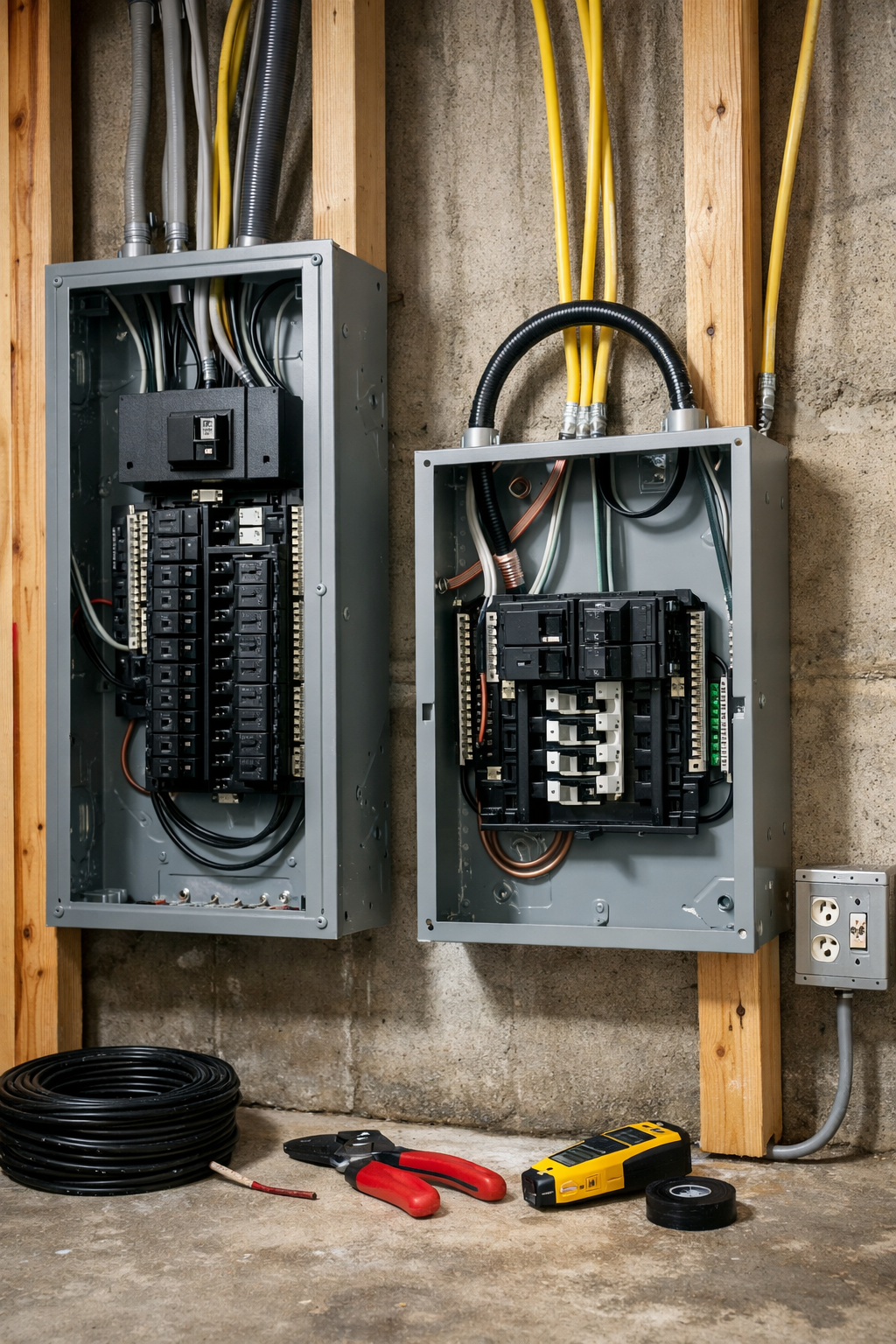
If you have ever flipped a breaker only to find that the lights dim every time the vacuum turns on—or worse, you have run out of physical slots to add that new home theater system or workshop outlet—you have reached the limits of your existing electrical infrastructure. While many homeowners assume that an overflowing panel means they need a full service upgrade (which involves upgrading the utility feed), there is often a more cost-effective and practical solution: subpanel installation. A properly executed subpanel installation allows you to expand your home’s electrical capacity without rewiring the entire house or upgrading your main service drop. At Tried & True Electrical Services Inc. , we view subpanels as the ultimate solution for power-hungry additions, home workshops, and multifamily conversions.
Recognizing the Signs: Is Your Main Panel Overwhelmed?
Before diving into the technicalities, it is important to recognize the telltale signs that your current setup is stretched too thin. Your main breaker panel acts as the central nervous system of your home, distributing power to individual circuits. However, most standard residential panels max out at between 100 and 200 amps. If you have recently finished a basement, added a mother-in-law suite, or installed a hot tub, you may be drawing close to that limit.
The most obvious sign is a lack of physical space. If you open your panel door and see no empty spaces for new breakers, you simply cannot add another circuit without removing or consolidating existing ones. Another sign is frequent nuisance tripping. While a breaker tripping occasionally is a safety feature, constant tripping indicates that you are asking your panel to handle more than it was designed to manage. Finally, if your lights flicker when large appliances cycle on, you are experiencing voltage drops caused by high demand on a single bus bar.
What Exactly is a Subpanel?
A subpanel (technically a “distribution panelboard”) operates as a mini satellite to your main panel. It is fed by a double-pole breaker in the main panel and sends power through a feeder cable to a separate enclosure located elsewhere in the house. Unlike the main panel, a subpanel does not have its own main disconnect breaker (though it often has a main breaker lug for local shutoff convenience). Instead, it relies on the breaker in the main panel for overcurrent protection.
Subpanels are ideal for creating “zones” in your home. For example, you might install a 60-amp subpanel in a detached garage to run welders and air compressors, or a 100-amp subpanel in a kitchen addition to handle new induction cooktops and ovens. Because the subpanel is downstream from the main panel, the neutrals and grounds must be isolated from each other. In a main panel, the neutral bar and ground bar are bonded together; in a subpanel, they must remain strictly separate to prevent ground loops and safety hazards.
The Anatomy of a Professional Subpanel Installation
A successful subpanel installation involves far more than simply hanging a metal box on the wall. It begins with a load calculation. Professional electricians must calculate the existing demand on your main panel and ensure that adding a subpanel will not overload the utility service. For instance, if you have a 200-amp main panel and you are currently drawing 120 amps, adding a 100-amp subpanel is feasible—but only if you do not plan to run every appliance at maximum capacity simultaneously. Electricians often apply a demand factor to prevent nuisance tripping at the main breaker.
Next comes the feeder wire. Unlike standard 15 or 20-amp branch circuits, subpanels require heavy-gauge cable—typically 2-6 AWG copper or aluminum, depending on the amperage and distance. Voltage drop is a critical consideration here. If your subpanel is located 150 feet away in a workshop, you may need to upsize the wire significantly to maintain consistent voltage. The cable must be secured properly, protected from physical damage, and terminated with torque-specific lugs.
Common Scenarios That Demand a Subpanel
1. The Detached Garage or Workshop:
This is the most frequent request we handle. Detached structures often receive power via a single 15-amp “spur” line, which is insufficient for modern tools. A subpanel fed by a direct-burial cable or overhead mast provides both convenience and safety.
2. The Kitchen or Luxury Addition:
Modern kitchens frequently require multiple 20-amp small appliance circuits, a dedicated circuit for the refrigerator, a microwave, and possibly a 50-amp range circuit. By the time you add under-cabinet lighting and a dishwasher, a single panel can be maxed out. Relocating these loads to a subpanel reduces clutter and shortens wire runs.
3. Solar or Battery Backup Integration:
Many homeowners are installing solar systems with battery storage. While some systems tie directly into the main panel, others require a “backup loads” subpanel that isolates essential circuits during an outage. This ensures your battery bank isn’t trying to power the central air conditioner when the grid goes down.
Cost vs. Value: Is it Worth It?
One of the primary reasons clients opt for a subpanel rather than a full service upgrade is cost. A full service upgrade (upgrading the mast, meter, and main panel) can run between $3,000 and $6,000 depending on your municipality and the utility company’s requirements. A subpanel installation, conversely, typically falls between $800 and $2,000, including labor and materials. This makes it an attractive option for those who have capacity headroom but simply need more “parking spaces” for breakers.
However, it is important to note that a subpanel does not increase the total power coming into your home. If your main service is 100 amps and you are currently using 95 amps, adding a subpanel will not magically grant you another 100 amps. It simply allows you to organize your existing capacity more effectively. In cases where the main panel itself is obsolete or the service conductors are undersized, a full upgrade remains necessary.
Why Trust Matters: Choosing the Right Contractor
Electrical work is not a DIY-friendly endeavor when it comes to panel work. The risks include arc flash, electrocution, and potential fire hazards. Furthermore, most jurisdictions require permits and inspections for subpanel installations. This is where partnering with an established, licensed firm makes all the difference. Tried & True Electrical Services Inc. brings decades of combined experience to the table, ensuring that every connection is torqued to spec, every ground is properly isolated, and every installation passes inspection on the first attempt.
We pride ourselves on transparency. Before we swing a hammer, we walk our clients through the load calculation and explain why we recommend specific amperage ratings and cable types. We also handle the utility coordination when necessary. For more information on how we can expand your home’s electrical capabilities, visit our main service page at Tried & True Electrical Services Inc. to schedule a consultation.
Safety Codes and Modern Requirements
Modern electrical safety has evolved significantly. According to the National Electrical Code (NEC), any subpanel installed in a garage, basement, or exterior location must now be protected by an arc-fault or ground-fault device in many scenarios. While the NEC requirements can be complex, the general trend is toward enhanced protection. To stay compliant, we often recommend installing subpanels with “main breaker” kits, as they allow for a local disconnect and can simplify future GFCI requirements. For those interested in the technical nuances of panelboard safety, this resource from the Electrical Safety Foundation International (ESFI) provides excellent supplementary information: ESFI Home Electrical Safety.
The Bottom Line
Your electrical panel should never be an afterthought. As homes become smarter and more electrified, the demand for clean, reliable power distribution continues to grow. A subpanel installation offers a flexible, cost-effective bridge between the power you have and the power you need. Whether you are carving out a home office, building an ADU, or simply tired of flipping breakers every time you microwave popcorn, a subpanel might be the perfect solution.
At Tried & True Electrical Services Inc. , we believe that expanding your home should be exciting, not frustrating. By offloading circuits to a dedicated subpanel, you reclaim the convenience and safety your home deserves. Contact us today to discuss whether a subpanel is the right fit for your next project.